
 English
 Español
 Portugues
 Pусский
 Français
 Deutsch
 ไทย
ไทย Türk dili
 Tiếng Việt


لوحة تحكم الطائرة بدون طيار FPV
FPV Drone Control Board: A Comprehensive Overview An FPV (First-Person View) drone control board, often referred to as a flight controller (FC), is the central processing unit responsible for stabilizing, maneuvering, and managing the drone’s flight dynamics. It serves as the brain of the drone, interpreting pilot inputs, sensor data, and external commands to ensure smooth and precise flight performance. Core Components and Functionality The control board integrates multiple critical components: 1. Microcontroller Unit (MCU): The primary processor executes flight algorithms, processes sensor data, and communicates with other peripherals. Common MCUs include STM32 series, known for their high performance and real-time processing capabilities. 2. Inertial Measurement Unit (IMU): Comprising accelerometers and gyroscopes, the IMU detects the drone’s orientation, angular velocity, and acceleration. Advanced boards may include barometers for altitude hold and magnetometers for heading stabilization. 3. Input/Output Interfaces: The FC connects to the receiver (for radio control signals), ESCs (Electronic Speed Controllers), video transmitters (VTX), and telemetry modules. Modern boards support protocols like PWM, SBUS, DSHOT, and Crossfire for efficient communication. 4. Firmware: Open-source firmware such as Betaflight, iNav, or KISS is flashed onto the board, enabling customizable tuning, flight modes (e.g., Acro, Angle, Horizon), and features like GPS navigation or autonomous waypoint missions. Key Features - High-Speed Processing: Essential for low-latency response in FPV racing or freestyle flying. - Sensor Fusion: Combines data from multiple sensors to enhance stability and reduce drift. - Onboard Blackbox Logging: Records flight data for post-flight analysis and tuning. - Compact Form Factor: Designed to fit lightweight builds, often in stackable configurations with PDBs (Power Distribution Boards) or 4-in-1 ESCs. Applications FPV control boards cater to diverse use cases: - Racing Drones: Prioritize minimal latency and high refresh rates. - Freestyle Drones: Emphasize smooth handling and customizable rates. - Long-Range/Cinematic Drones: Integrate GPS and advanced stabilization for endurance flights. Conclusion The FPV drone control board is a sophisticated yet compact system balancing computational power, sensor accuracy, and real-time adaptability. Its continuous evolution drives innovation in drone performance, enabling pilots to push the boundaries of speed, agility, and autonomous capabilities.
نتاج
تصنيف:
-
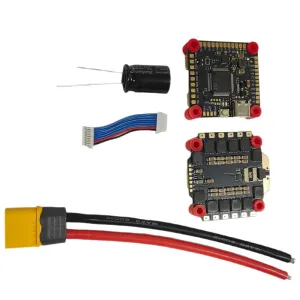
لوحة تحكم الطيران بدون طيار FPV
تصنيفها: ملحقات الطائرات بدون طيارالمشاهدات: 130عدد:وقت الإصدار: 2025-10-13 17:07:30XYH FPV Drone Flight Controller Board (F405 V2+60A) يدمج وحدة تحكم الطيران 4-8S و4 في 1 ESC، ويتميز بشريحة STM32F405، وجيروسكوب ICM42688P، وتيار مستمر 60 أمبير. متوافق مع إطارات fpv من ألياف الكربون، ومجموعات طائرات بدون طيار FPV مقاس 5 بوصات، وطائرات السباق بدون طيار، فهو يضمن أداءً ثابتًا وعالي الطاقة لتطبيقات FPV.نظرة عامة على المنتجتعد لوحة التحكم في الطيران بدون طيار FPV (F405 V2 + 60A) حلاً ممتازًا شاملاً للطائرات بدون طيار عالية الأداء، حيث تجمع بين وحدة التحكم في الطيران الغنية بالميزات مع ESC قوي 4 في 1. باعتبارها مكونًا حاسمًا لإطارات طائرات بدون طيار لسباقات ألياف الكربون ومجموعات ط...
أخبار
تصنيف:
لا توجد نتائج بحث!
حالة
تصنيف:
لا توجد نتائج بحث!
فيديو
تصنيف:
لا توجد نتائج بحث!
تحميل
تصنيف:
لا توجد نتائج بحث!
تجنيد
تصنيف:
لا توجد نتائج بحث!
المنتجات الموصى بها
لا توجد نتائج بحث!



 هاتف
هاتف